
How many restrooms does a race need?
Start with the crowd, then split it by location. A finish line holding 800 runners plus spectators pulls differently than a water station two miles out. Marathon and race restroom planning usually clusters 3 to 4 standard units at the start, mirrors that at the finish, and drops single units or pairs at aid stations along the way. OSHA 1926.51(c) sets construction ratios at one toilet for 20 workers or fewer, and while a race is not a job site, race directors in Visalia use the same logic: more people, more fixtures, closer together.
Pricing follows unit count and rental length. A standard porta potty rental runs $200 to $800 for an event booking, and a deluxe flushable porta potty for VIP or sponsor areas can run higher per day depending on servicing needs. Races near Visalia sometimes route through areas closer to Farmersville, 8.8 miles east, or Patterson Tract, 5.9 miles northeast, and course length changes unit placement more than it changes total count. Always add at least one ADA accessible porta potty per cluster; ADA Standards section 213.2 requires 5 percent of clustered single-user units to be accessible, with a minimum of one no matter how small the cluster.
| unit | duration | typical price |
|---|---|---|
| standard | event | $400 |
| ada | day | $230 |
| deluxe | day | $300 |
| trailer | event | $3,500 |
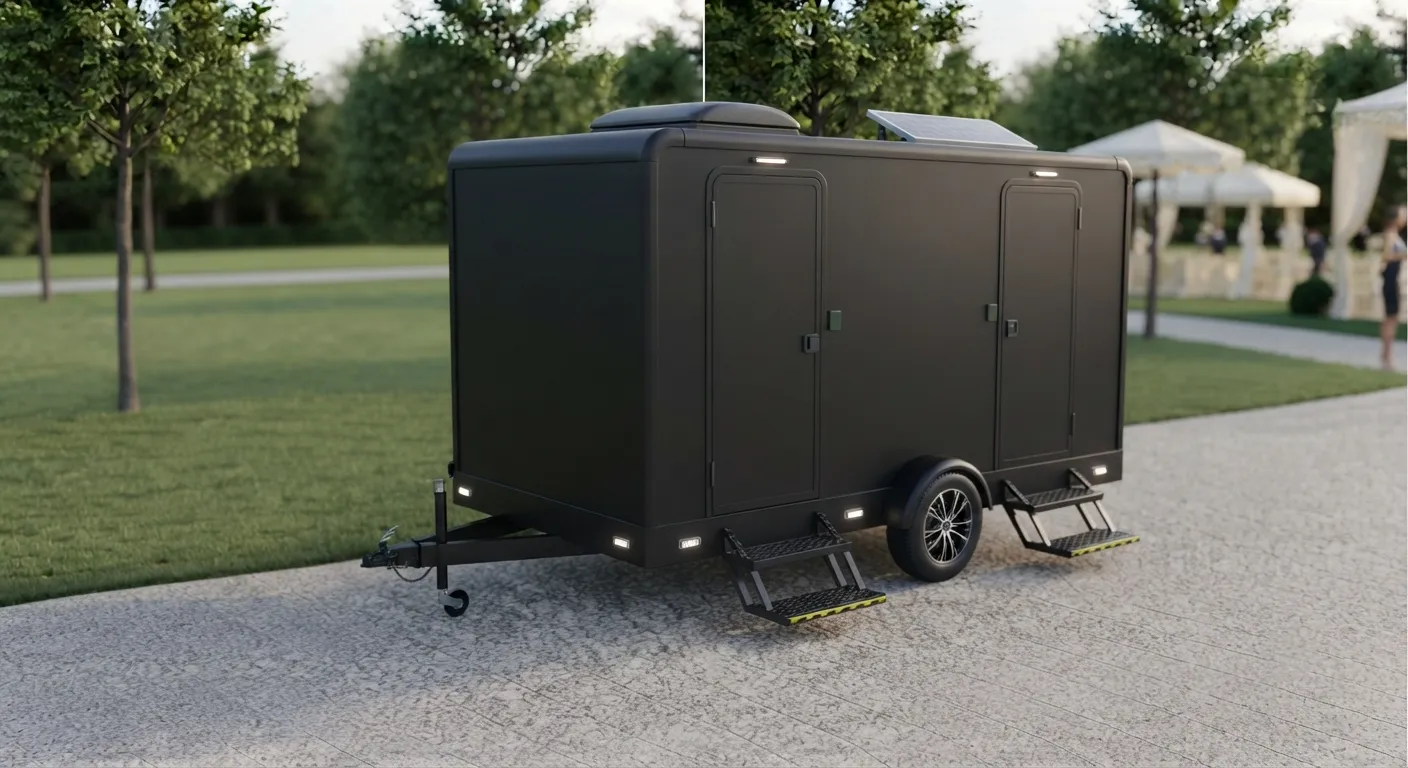
For bigger fields, a restroom trailer rental or an 8 stall restroom trailer at the finish line handles surge traffic better than a wall of single units, especially when spectators linger for awards.
Where should restrooms go along the course?
Placement drives everything. Units belong where crowds gather and vehicles can reach them: start corrals, finish chutes, aid stations, and anywhere a course loops back near a road. A porta potty placement guide helps organizers avoid blocking sightlines or emergency lanes. Ground surfaces matter too; ADA Standards section 302.1 calls for stable, firm, slip-resistant footing, which rules out soft turf or loose gravel for accessible units.
Delivery access matters as much as final position. A roll-off or trailer delivery in Visalia needs roughly 60 feet of straight clearance behind the truck, so aid stations tucked into narrow trailheads or tight parking lots need a rethink before race day. If the course runs near event infrastructure like light towers or a generator, ask about how to brace a temporary power pole. A temporary power pole supporting timing equipment or lighting needs guying or a stable base plate, since wind and foot traffic near a finish line can knock over a poorly anchored pole fast.
If the race crosses public right-of-way, confirm placement with the City of Visalia before locking the layout; permit rules for street or sidewalk use are not something we'll guess at here, so check directly with the city. For crowd flow near restroom clusters, a crowd control barrier rental or temporary fence rental keeps lines orderly and keeps runners from cutting through service areas. Add handwashing station rental units next to food and medical tents; 29 CFR 1910.141(d)(2) requires soap and towels or a hand-drying device at washing stations, since sanitizer alone doesn't meet that standard.
How far in advance should we book?
Book 4 to 6 weeks out for anything over 500 runners, sooner for holiday-weekend races when trailers and ADA units get scarce fast. Smaller local fun runs can often book a couple weeks ahead, but course closures and city coordination take longer to lock in than the rental itself. Request a quote once you have a rough headcount and course map; final unit counts can shift once you know where medical tents and water stations land.
Servicing during a race weekend is different from a weekday job site. ANSI/PSAI Z4.3 sets a baseline of one service visit per week for up to 10 users over a 40 hour week, but race day compresses thousands of uses into a few hours, so most Visalia races schedule a mid-event or post-event service call rather than relying on the weekly baseline. If your race includes an expo, packet pickup, or vendor village the day before, treat that as a separate event needing its own event restroom rental count, not an extension of race-day units. Delivery fees for events land between $100 and $500 depending on distance and timing, so bundling drop-off and pickup into one visit keeps costs down. For races that also draw a festival crowd, check festival restroom rental or concert restroom rental for a sense of how vendor and stage areas get handled separately from the running course itself.
Frequently asked questions
How many porta potties do I need for a 5k?
For a 5k with 300 to 500 runners, plan on 6 to 10 standard units split between start and finish, since most runners finish within an hour and traffic is concentrated. See how many porta potties do I need for a fuller breakdown by event type.
Do we need ADA units for a race?
Yes. ADA Standards section 213.2 requires at least one accessible unit per cluster, even for a small race. Pair accessible units near ramps or flat ground, since ADA Standards section 405.2 caps ramp slope at 1:12 for any raised platform units.
Can restrooms be moved mid-race?
Units can shift between waves if the course has multiple laps, but plan this with your vendor before race day. Mid-event moves cost more than pre-planned placement and risk delays if trucks can't reach the new spot in time.
What if we need restrooms on short notice?
Call an emergency porta potty rental line if a permit gets approved late or weather forces a course change. Same-day fulfillment depends on inventory, so earlier booking always beats a rush order.
Do restroom trailers work better than standalone units?
For finish-line areas with heavy foot traffic, yes. A 4 stall restroom trailer or larger handles bursts of use better than several single units, and it's easier to service between race waves.
Next step
Get a delivery date
Tell us the address, the dates and the headcount. We size the order and confirm the route.